An estate planning social media marketing case study by Setasa Marketing
9.46 million Reel views. Thousands of new follows. And a bigger question: How do law firms turn that kind of attention into paying clients?
For many law firms, social media presents a familiar dilemma.
They understand the value of being visible online. They know their expertise deserves an audience. And they recognize that prospective clients increasingly research attorneys before making contact.
But visibility alone doesn’t answer the question that matters most to the business:
Is our marketing helping us attract more of the clients and matters we want?
At Setasa Marketing, this question shapes how we approach legal marketing.
Our work with an established estate planning law firm offers a useful example of what strategic content can accomplish, and why the next opportunity for law firms lies in connecting that content to a stronger client acquisition system.
The client: An established estate planning practice
Our client is an estate planning law firm with approximately three attorneys and a wider team of legal and administrative professionals.
Unlike firms that are hesitant to participate in social media, this practice was comfortable putting its attorneys and team in front of the camera.
Its content wasn’t limited to formal legal education.
The firm was open to exploring multiple aspects of its identity online, including:
- Educational videos addressing common estate planning questions.
- Relatable content about family life and legal concerns.
- Humor, memes, and culturally relevant conversations.
- Attorney personalities and professional perspectives.
- Behind-the-scenes moments that reflected the firm’s culture.
That openness gave us opportunities to connect with audiences beyond people actively searching for an estate planning attorney.
It also created an important strategic advantage: we could present legal professionals as knowledgeable and approachable without removing the personality that made the content interesting.
The opportunity: Make estate planning relevant before someone searches for an attorney
Estate planning is an unusual service to market.
Many people understand that they should have a will or an estate plan, but they may not feel an immediate need to act.
Trust & Will’s 2026 Estate Planning Report found that 73% of Americans surveyed believed estate planning was personally important, yet 56% reported having no estate planning documents.
For law firms, this creates a significant gap between awareness and action.
It also creates a content challenge.
A prospective client may not be particularly interested in learning the technical differences between a will and a trust.
But that same person may be deeply interested in what would happen to their children, their home, or their family’s finances if they were no longer able to manage those responsibilities.
The difference is where the conversation begins.
Rather than approaching every topic from the attorney’s professional vocabulary, effective content can begin with the situations prospective clients already understand.
Estate planning then becomes relevant to the person’s life instead of remaining an abstract legal service.
Our approach: Build multiple reasons for an audience to engage
For this client, content could serve several complementary purposes.
1. Education that makes legal issues understandable
Estate planning involves decisions with serious financial and personal consequences.
Educational content helps audiences understand unfamiliar concepts, recognize relevant questions, and appreciate when professional legal guidance may be appropriate.
But education becomes more compelling when it connects legal principles to everyday circumstances.
Rather than simply introducing a legal document, content can begin with a recognizable question:
“What happens if both parents are no longer able to care for their children?”
The attorney can then explain the relevant planning considerations.
2. Relatable content that encourages sharing
Estate planning intersects with subjects people already discuss: marriage, parenting, relationships, inheritance, money, and family responsibilities.
These conversations create natural opportunities for relatable short-form content.
A viewer might share a Reel with a spouse, sibling, or friend because the subject reminds them of a conversation they’ve had.
This is particularly valuable because shared content can introduce an attorney to people who weren’t actively looking for legal information.
3. Humor and personality that make the firm memorable
Legal expertise is essential, but it doesn’t require every social media post to feel formal.
Our client was comfortable incorporating humor and memes alongside its educational content.
This allowed the firm to participate in everyday online culture while maintaining a professional identity.
Humor can make a firm more approachable, while content featuring attorneys and staff can help prospective clients become familiar with the people behind the practice.
4. A recognizable firm culture
For professional services, the relationship often matters as much as the service description.
Prospective clients may want reassurance that the attorney is knowledgeable, approachable, and able to communicate clearly about sensitive subjects.
Showing the firm’s people and culture creates additional opportunities to develop that familiarity.
Together, these different content approaches create a more complete online presence than educational posts alone.
The results: More than 9.4 million views across six Reels
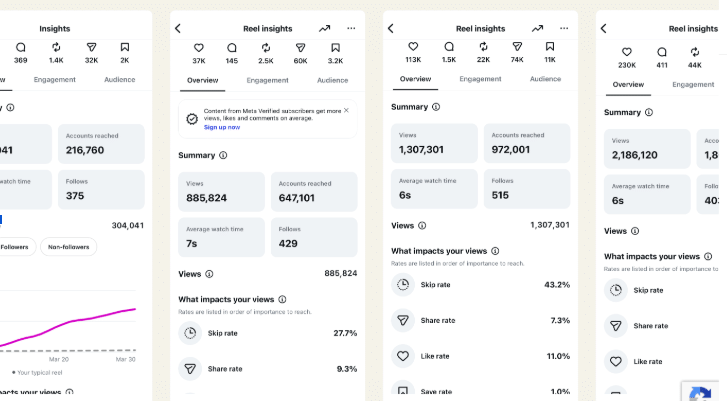
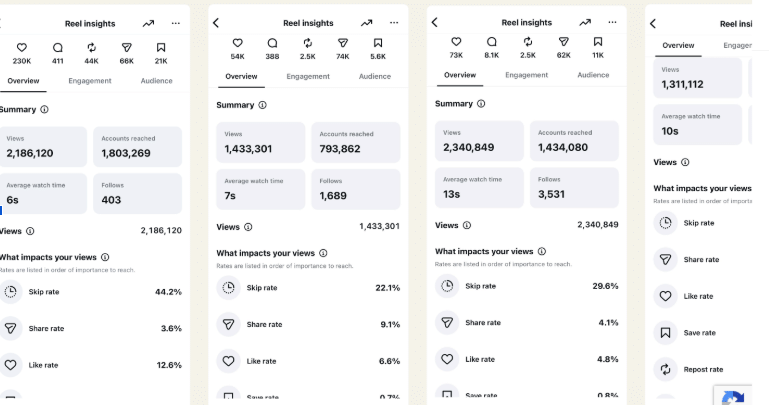
The performance data from six identifiable Reels demonstrates the scale of attention generated through the firm’s content.
| Reel | Views | Accounts reached |
| Reel 1 | 885,824 | 647,101 |
| Reel 2 | 1,307,301 | 972,001 |
| Reel 3 | 2,186,120 | 1,803,269 |
| Reel 4 | 1,433,301 | 793,862 |
| Reel 5 | 2,340,849 | 1,434,080 |
| Reel 6 | 1,311,112 | Not fully visible |
| Total | 9,464,507 | 5,650,313 across the five Reels with visible reach data |
These view and reach totals are cumulative platform measurements, not unique individuals across the campaign.
The five Reels with visible follow data also recorded a combined 6,567 follows.
One Reel alone generated more than 2.34 million views, 1.43 million accounts reached, and 3,531 follows.
Another attracted more than 74,000 shares, demonstrating the extent to which viewers distributed the content beyond the firm’s immediate audience.
Source: Instagram Reel Insights screenshots supplied for the client account. Results represent selected Reels, not the entire account’s performance.
These results demonstrate a meaningful capability: an estate planning practice can reach audiences at substantial scale without limiting its content to traditional legal explanations.
But they also introduce an important question.
What happens after someone watches?
The missing piece: Connecting visibility to retained clients
Although we could measure content performance, we did not have access to the firm’s complete consultation, intake, and retained-client records.
That means we cannot accurately report how many of these viewers contacted the firm, booked consultations, or became paying clients.
This is an important distinction.
Millions of views demonstrate visibility. Thousands of follows demonstrate audience growth.
Neither automatically establishes return on marketing investment.
To understand commercial impact, a law firm needs visibility into the entire customer journey, from the first interaction with its content to the final decision to retain an attorney.
And that is where we see a major opportunity for law firms heading into 2027.
What a complete content-to-client acquisition system would look like
If we were designing an expanded growth system around this level of social media attention, we would connect content to several distinct conversion pathways.
The objective would be to make the right next step available to someone based on how ready they are to seek legal help.
Pathway 1: The person ready to hire an attorney
Imagine a prospective client watching a video about the difference between a will and a trust.
They already know they need professional advice, but they are comparing options.
For this person, we would provide a direct route from the content to a relevant landing page.
That page would explain who the firm helps, the services offered, what the process involves, and how to schedule a consultation.
There would be no reason to require the prospect to download a guide and wait through an email sequence before contacting the firm.
When someone is ready, the objective is to reduce unnecessary friction.
Pathway 2: The interested parent who isn’t ready to book
Now imagine a parent watching a video about appointing guardians for minor children.
The content raises a question they hadn’t considered, but they are not yet ready to contact an attorney.
For this audience, we could offer a free Family Estate Planning Starter Checklist.
The resource would help parents identify important planning questions and understand when professional advice may be appropriate.
After downloading, they could receive a short, consent-based email series addressing common questions, misconceptions, and the firm’s planning process.
Each email would include an appropriate invitation to explore the firm’s services or request a consultation.
The purpose wouldn’t be to pressure someone into making an immediate decision.
It would be to help them move from uncertainty toward informed action.
Pathway 3: The referral or research-stage prospect
Not everyone will contact an attorney directly from Instagram.
Someone might discover the firm through a Reel, then search for its name on Google several weeks later.
That person may visit the website, read reviews, explore attorney biographies, and compare local firms before making contact.
For this pathway, the website, local search presence, and overall reputation are essential.
The social media content starts or strengthens the relationship, while other digital touchpoints help the prospective client evaluate the firm.
Modeling the opportunity: What might a conversion system have captured?
To illustrate the potential value of a fully integrated acquisition system, consider a hypothetical funnel built around the six Reels’ combined 9.46 million views.
Suppose visits to targeted landing pages were equivalent to just 0.02% of those views.
That would represent approximately 1,893 landing-page visits.
If those visits converted at 6.3%, the median legal landing-page conversion rate reported by Unbounce, the pages would generate approximately 119 conversion actions.
Depending on the offer, those actions could include resource downloads, inquiries, or consultation requests.
Now assume that 20% of those conversions met the firm’s geographic and service qualifications.
That would leave approximately 24 qualified prospects.
If half booked consultations, three-quarters attended, and 40% of attendees retained the firm, the modeled outcome would be approximately three to four new clients.
These are hypothetical calculations, not results achieved or measured for this client.
The visitor rate, qualification rate, booking rate, attendance rate, and retention rate are illustrative assumptions. Actual outcomes could be substantially lower or higher depending on audience location, content relevance, service demand, pricing, and intake performance.
The point is not to suggest that social media views can reliably be converted into a predetermined number of clients.
It is to demonstrate why even a modest amount of measurable commercial activity can become meaningful when a practice has already established substantial online visibility.
Without the infrastructure to capture and track that activity, the opportunity remains difficult to quantify.
The 90-day strategy we would recommend
For law firms looking to connect marketing to business outcomes more quickly, we recommend operating two growth systems at the same time.
The first captures existing demand. The second develops future demand.
First 30 days: Capture existing demand
Prioritize prospects already researching an estate planning service or considering hiring an attorney.
Publish content addressing high-intent questions, improve relevant service pages, create direct consultation pathways, and establish lead tracking.
The firm should be able to identify where inquiries originate and what happens to them after first contact.
Days 31–60: Build conversion pathways
Introduce targeted resources for prospects who aren’t ready to book immediately.
Connect those resources to relevant follow-up emails and simple opportunities to request a consultation.
Continue publishing content that makes estate planning relevant to recognizable life situations.
Review which subjects generate not only engagement but also qualified inquiries.
Days 61–90: Measure and optimize
Evaluate consultations booked, attendance rates, new matters, and revenue associated with marketing.
Identify which audience segments, content types, and conversion pathways are creating the strongest business opportunities.
Use that information to guide the next phase of content production and acquisition.
The objective is to establish a measurable system that the firm can improve over time.
What this experience reinforced for us
Working with a law firm that was comfortable embracing education, humor, attorney personality, and firm culture demonstrated how many different ways legal professionals can connect with an audience online.
The documented content results were substantial.
But our broader strategic conclusion is that visibility and conversion should not operate as separate marketing objectives.
A firm needs content that attracts and engages prospective clients.
It also needs a process that helps interested people move toward booking a consultation, and a way to measure whether those consultations become new business.
That combination is where social media begins to function as part of the firm’s broader client acquisition strategy.
The takeaway for estate planning attorneys
Estate planning is deeply personal.
People are not simply purchasing documents. They are making decisions about family, property, relationships, financial responsibility, and the future.
Effective marketing begins by understanding the circumstances that make those decisions relevant.
It speaks in language the prospective client recognizes.
It uses education, personality, and clear communication to establish familiarity and trust.
And when someone is ready for legal help, it makes the next step straightforward.
Your content should do more than get attention. It should give the right people a reason and a way to become clients.
That is the opportunity we believe estate planning firms should be preparing for in 2027.
Ready to Connect Your Content to Client Growth?
At Setasa Marketing, we help attorneys turn their expertise into content that people understand, remember, and engage with.
We focus on the connection between audience psychology, professional positioning, meaningful visibility, and measurable business opportunities.
If your law firm is showing up consistently online but you’re unsure how that activity contributes to new business, start with our free guide:
From Content to Clients: The 2027 Estate Planning Growth Playbook
Inside, you’ll find a practical 90-day framework for planning content, capturing inquiries, developing conversion pathways, and tracking results beyond views and followers.
Download the free playbook or schedule a strategy conversation with Setasa Marketing.
Setasa Marketing. Heart-led. Data-backed. Built for law firms.
Sources and methodology
- Instagram Reel Insights screenshots provided by the client. Metrics represent selected content, and totals may include repeat viewers.
- Trust & Will, 2026 Estate Planning Report.
- Unbounce, Legal Industry Conversion Rate Benchmarks. Reported median landing-page conversion rate: 6.3%.
- Modeled conversion outcomes are illustrative and do not represent actual or promised results.